
The ball was already past Bert Williams before anyone in the stadium understood what they had seen.
It came in from 25 yards, a long shot off the boot of a midfielder named Walter Bahr, moving toward the goalkeeper's right. A man threw himself at it near the penalty spot, headlong, and the flight of the ball changed. It went into the side of the net. The 38th minute. The only goal of the match. The United States beat England 1-0 at the Estádio Independência on June 29, 1950, in front of an official crowd of 10,151, and the man who scored it was on the ground when it crossed the line.
No film exists. There was no American broadcaster on the hill in Belo Horizonte that afternoon. The single American sportswriter who was there had paid his own way. The only goal of that match survives only in still photographs and in the words of the men who were standing near enough to describe it. The goal is owned by us. We retell it every four years. The name of the man on the ground is not.
His name was Joe Gaetjens.
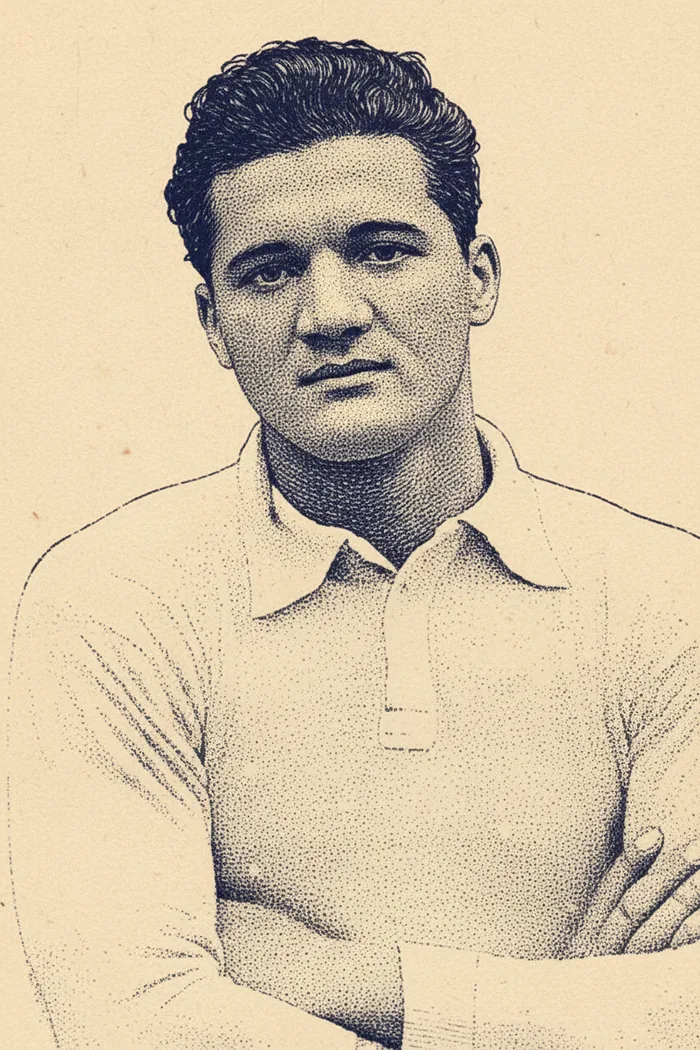
He was Haitian. He had been in New York for three years. He was paid $25 a game.
Start with the eleven who played, because the men are the fact. The United States went out in Belo Horizonte with Borghi in goal; Keough and Maca at the back; McIlvenny as captain, Colombo, and Bahr across the middle; Wallace, Pariani, Gaetjens, John Souza, and Ed Souza ahead of them. England answered with Williams in goal; Ramsey and Aston; Wright, the captain, with Hughes and Dickinson; Finney, Mannion, Bentley, Mortensen, and Mullen. Stanley Matthews was rested. The American coach, Bill Jeffrey, had told the press before the match that his players were “sheep ready to be slaughtered.”
The sheep won. When the result reached England, Arthur Drewry, the chief delegate, called it “unbelievable,” and the English papers ran it inside Friday's editions, small wire items. Bahr would spend the rest of his life describing the goal to anyone who asked. Years later he told it the way he always did. He had taken “a shot from 25 yards out that was moving to the goalkeeper's right.” And then, somehow, Joe Gaetjens got to the ball.
Somehow is the honest word. Whether Gaetjens deliberately headed the ball or whether it glanced off him as he dove has never been settled by anyone who was there. The photographs do not resolve it. The men who saw it did not agree.
But, on the day he scored the only American goal, we do know that Joe Gaetjens was not a United States citizen. He had signed a declaration of intention to become one and never finished. He played for Haiti's national team before the World Cup and after it.
Before the goal Gaetjens was a dishwasher.
He came to New York in 1947 on a Haitian government scholarship to study accounting at Columbia. He washed dishes at Rudy's Cafe, a Spanish restaurant on the corner of 111th Street and Lenox Avenue in Harlem. The owner, Eugene “Rudy” Diaz, also owned a soccer club called Brookhattan, and a man who could wash dishes and score goals was worth more to Diaz than a man who could only do one.
Gaetjens played for Brookhattan in the American Soccer League from 1947 to 1950. He scored 14 goals in his first season. In 1949-50 he led the league with 18 goals in 15 games.
He was not, on paper, an obvious American hero. He was a Haitian studying accounting in Manhattan who happened to be very good at football.
The family reached back to Bremen. His great-grandfather, Thomas Gaetjens, had come to Haiti from the German port around 1825, by family tradition as a commercial emissary under King Friedrich Wilhelm III of Prussia, and had married Léonie Déjoie, the daughter of a Haitian general. Joe's father registered his birth at the German embassy in Port-au-Prince so the family could claim German nationality. Joe was born there on March 19, 1924. He joined the club Étoile Haïtienne at 14 and won the Haitian league with them in 1942 and 1944.
The man who scored against England in Belo Horizonte was the great-grandson of a Prussian trader, the descendant of a Haitian general, a Columbia accounting student, and a dishwasher in Harlem, all at once.
After the World Cup, Europe came for him.
He signed with Racing Club de Paris for 1951-52 and played 4 league matches, scoring 2. He moved down to Olympique Alès in the second division for 1952-53, 15 matches, 2 goals. A knee injury slowed him. He struggled with the discipline of the French league. And then he went home. He returned to Port-au-Prince in 1953 and did not leave again.
He opened a dry-cleaning business. He coached youth football at his old club. He played in a World Cup qualifier against Mexico. In 1955 he married Lyliane Defay and they had three children. The eldest was named Lesly.
He was related, through the Déjoie line his great-grandmother came from, to Louis Déjoie, who ran for president of Haiti in 1957 and lost to François Duvalier. Joe campaigned for Déjoie. He was a man with a business, a wife, three children, and a candidate he had backed who had lost.
Then on July 7, 1964, François Duvalier declared himself president for life.
The next morning most of the Gaetjens family went into hiding or left the country. Joe's two younger brothers, Jean-Pierre and Fred, had already gone into exile in the Dominican Republic, where they were associated with a group plotting against Duvalier, and that association was enough to put the whole family in danger. Joe would not go. He said he was apolitical. He said a childhood friend of his, a man named Daniel Beauvoir who had risen to become a chief in Duvalier's Tonton Macoute, would protect him.
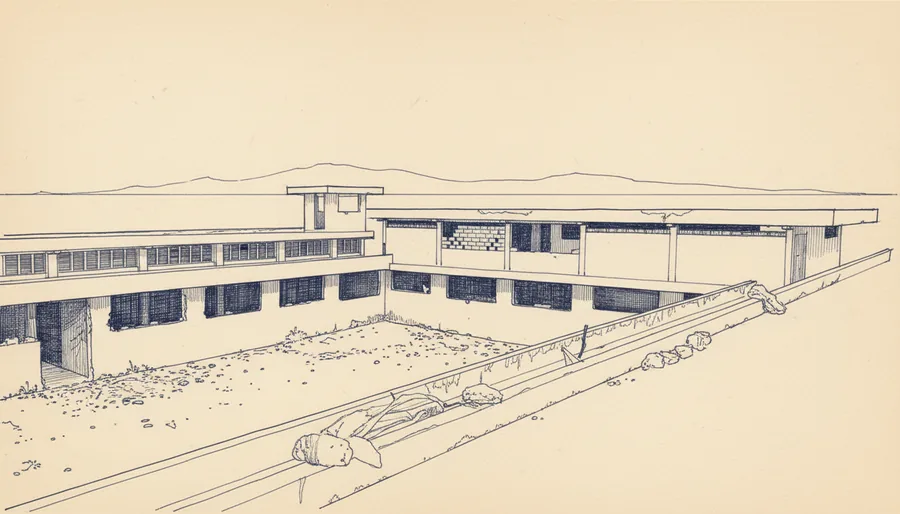
On the morning of July 8, 1964, at 10:00 a.m., at his dry-cleaning shop in downtown Port-au-Prince, a uniformed police lieutenant named Edouard Guillot and two armed men in plain clothes took Joe Gaetjens away. There were many witnesses. He was taken to Fort Dimanche. We know the name of the officer because the Inter-American Commission on Human Rights named him in its 1979 report on Haiti. We do not know more from the Haitian state, because when the Commission asked the Haitian government for information about the case, the Haitian government did not reply.
The state did not look for him. The family looked.
They paid $4,000 to a man at a flour mill who said he could get Joe released. The money came back. It was returned to the family with the words, “Here's your money back. Joe Gaetjens is dead.” His wife Lyliane telephoned the friend who had promised protection, Daniel Beauvoir, and asked him to intervene. He said there was nothing he could do.
What happened inside Fort Dimanche is known only once removed. Years later, after Jean-Claude Duvalier fell in 1986 and exiles could return, Joe's brother Jean-Pierre met a man who had been imprisoned there with Joe and was moved out one night just before. “You were lucky,” the man told him, “because last night they had killed everybody at Fort Dimanche.” That night was sometime in the middle of July 1964, within days of his arrest. Joe was most likely killed then. His body was never found. There is no grave and no marker. He is most likely in the unmarked ground behind the prison.
The terror did not end with Joe, and it did not end with Papa Doc's death in 1971. Joe's older brother Gérard, harassed by the regime for years, went back to Haiti and was killed in a politically motivated attack in 1990.
“Here's your money back. Joe Gaetjens is dead.”
American coverage called the building Fort Dimanche. Sunday Fort.
The people who lived under it called it something else. Fort la Mort. The Fort of Death.
Jean-Bertrand Aristide, the first democratically elected president, created the Commission Nationale de Vérité et de Justice after his return in 1994, and it delivered its report on February 5, 1996. By the decree that created it, its mandate covered only the coup years, from September 30, 1991, to Aristide's restoration in 1994. It was not permitted to investigate the Duvalier dictatorship. Not by oversight. By design. The only official Haitian inquiry into political killing could not, by law, name the men who killed Joe Gaetjens, and no Haitian process ever has.
The United States National Soccer Hall of Fame inducted Joe Gaetjens in 1976. It did so as part of inducting the whole 1950 squad as a class, twelve years after he was taken from his shop.
He came to New York in 1947, the same year Jackie Robinson broke baseball's color line, and the country began, slowly, to recognize who we are. Three years later it sent eleven men to Belo Horizonte. A Belgian at the back. A Scot with the captain's armband. The sons of Italian immigrants in goal and across the front. And a Haitian who had never finished becoming a citizen.